What Time Zone Is Samoa In?
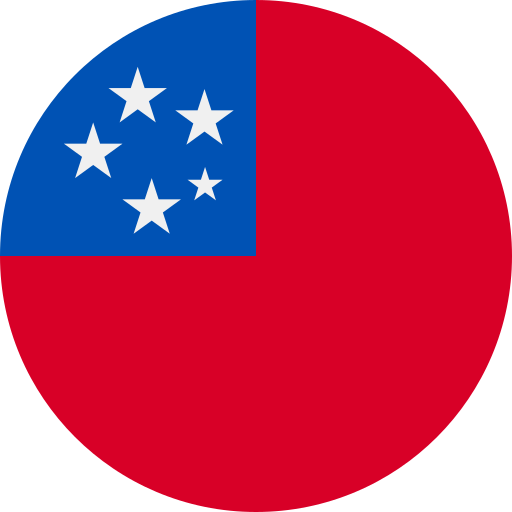
Samoa uses a single timezone: the primary designation is Pacific/Apia, which is currently UTC+13:00 from Coordinated Universal Time. The IANA Time Zone Database , the authoritative global reference used by operating systems, web services, and programming languages worldwide, lists this as Pacific/Apia.
Regional Context
Polynesia's timezones span the widest range globally: from American Samoa (UTC-11:00) to Tonga (UTC+13:00), a 24-hour spread across the Date Line. Samoa crossed the International Date Line in December 2011, jumping from UTC-11:00 to UTC+13:00 to align with Australian and New Zealand trading partners (the move meant "losing" a Friday permanently). Tonga operates at UTC+13:00 year-round. French Polynesia (Tahiti) uses UTC-10:00 year-round. Hawaii (UTC-10:00) is technically in Polynesia culturally, though politically part of the US. The Cook Islands use UTC-10:00. Niue uses UTC-11:00. No Polynesian nation currently observes Daylight Saving Time.
Current Time in Apia
The capital city Apia observes the Pacific/Apia timezone, currently at UTC+13:00. The live clock above updates every second using your browser's Intl.DateTimeFormat API with the IANA zone identifier. To convert Apia time to UTC, subtract the offset shown: Apia's local time minus 13:00 hours equals UTC.
Daylight Saving Time in Samoa
The DST status for Samoa is shown in the indicator above. When DST is in effect, clocks advance by one hour, temporarily shifting Samoa's UTC offset by +1. Countries that do not observe DST, including Japan, China, India, and most of Africa, maintain a fixed offset year-round. The IANA Time Zone Database contains the complete historical record of DST transitions for Pacific/Apia, including past rule changes and future scheduled transitions.
Scheduling Calls With Samoa
When arranging calls or meetings with contacts in Samoa, standard business hours run 09:00 to 18:00 local time (Pacific/Apia). In UTC, that window is 20:32 to 05:32 UTC. The time difference tool on this site calculates the overlap between any two cities' business hours, so you can find the shared window without mental arithmetic. If you're in a different country, visit the time difference page for your city vs. Apiafor a full hour-by-hour breakdown.
Timezone Abbreviation for Samoa
The GMT+13 abbreviation appears on airline tickets, broadcast schedules, and financial contracts when referencing Samoa time. Timezone abbreviations are not globally unique, IST, for example, can mean India Standard Time (UTC+05:30), Irish Standard Time (UTC+01:00), or Israel Standard Time (UTC+02:00). The IANA identifier Pacific/Apia is unambiguous: it maps to exactly one timezone in the world. When writing times for a global audience, always include both the abbreviation and the UTC offset to prevent misreading. The IANA Time Zone Database records every past and future rule change for Pacific/Apia, making it the only reliable reference for historical time conversions.
Calling Samoa from Abroad
International callers reach Samoa using the code +685. Standard business hours run 09:00 to 18:00 local (Pacific/Apia), which in UTC is 20:32 to 05:32 UTC. The best window for international calls is 10:00 to 16:00 Samoa local time, after the morning rush and before post-17:00 wind-down. Mobile coverage in Apia follows local carrier standards. International roaming calls to Samoa are billed at the caller's international rate, not the local Samoa rate.
Currency and Banking Hours in Samoa
Domestic banks in Apia operate on Pacific/Apia time. Wire transfers, invoice settlements, and currency conversions must typically be initiated before 17:00 Samoa local time to be processed same-day. The forex market trades 24 hours, but domestic banking settlement in Samoa follows Pacific/Apia business hours. When sending international transfers to Samoa, factor in the UTC offset (UTC+13:00) to ensure your instruction arrives before the local cut-off time. Same-day settlement typically requires initiation before 02:32 UTC.
Samoa: A Single-Zone Country
Samoa observes a single timezone nationwide: Pacific/Apia (UTC+13:00). Single-zone countries have a scheduling advantage, there is no ambiguity about which zone a meeting time refers to, and businesses across the country share the same clock. This simplifies domestic commerce, broadcast scheduling, and government coordination.